






Shopping for a Used Dodge Challenger? Here’s Your Engine Guide

Some drivers are drawn to muscle cars like moths to a flame. They revel in the idea of a powerful car, tuned to perfection, roaring down the street and turning heads. The Dodge Challenger has always exemplified these characteristics. The Challenger merges performance and bold, eye-catching style, its intimidating body veering into view hood first. A fan favorite in the muscle car segment, it’s no surprise the DodgeChallenger has reigned supreme since its release in 1970. After being discontinued in 1984, the Challenger came roaring back onto the scene in 2008 and has seen several major updates in the years since. With so many different options available, finding the right used Dodge Challenger for sale can pose many questions for prospective buyers.
It’s always helpful to begin by researching the components that matter to you most. Maybe you’re looking for a car based on the specifications of the powertrain. It’s easy to see how the engine and transmission matter when considering a vehicle of this caliber. Shopping for a performance-forward car without having the performance details at your fingertips can be daunting. That’s why we’ve assembled this helpful buyer’s guide for Dodge Challenger engines from recent model years, starting in 2015 and working our way up to the present. While there are more than engine specifications to consider, narrowing down the powertrain can help drivers find the vehicle that best suits their needs.
2015 Challenger Engines
The 2015 Dodge Challenger is available in several different engines, depending on which trim you find. The base engine is the 3.6L Pentastar V6, which has an output of 305 hp and 268 lb-ft of torque and is offered in the SXT trim. Moving up the ladder to the R/T trim, you will find a 5.7L V8 that produces up to 375 hp and 410 lb-ft of torque. The R/T Scat Pack is equipped with a much larger 6.4L V8 engine that produces 485 hp and 475 lb-ft of torque. In 2015, Dodge also began the production of the now-legendary SRT Hellcat, featuring a behemoth supercharged 6.2L V8 that produces 707 hp and 650 lb-ft of torque. While the V6 is only available with an eight-speed automatic transmission (which was new for 2015), all the more powerful engines also offer a six-speed manual.
2016 Challenger Engines
The 2016 Dodge Challenger is available in four different engine configurations. For the SXT and SXT Plus trims, you’ll get a 3.6L V6 engine that produces 305 hp and 268 lb-ft of torque. Most R/T trim levels offer a 5.7L HEMI V8. This pushrod 16-valve engine produces up to 375 hp and 410 lb-ft of torque. Moving to the R/T Scat Pack and SRT 392 ups the ante to a 6.4L HEMI V8 with an output of 485 hp and 475 lb-ft of torque. Finally, the SRT Hellcat is the most powerful Challenger with a supercharged pushrod 16-valve 6.2L V8 with an astounding 707 hp and 650 lb-ft of torque.
There are two transmissions depending on the engine. There is an eight-speed automatic transmission that is standard with the V6 and optional on the V8s. If you’re craving a closer connection to the Challenger, the V8s are available with a six-speed manual transmission. The Challenger has rear-wheel drive and independent rear suspension that varies according to the model. By all accounts, the 2016 Challenger SXT is a firmer drive than its 2015 predecessor.
2017 Challenger Engines
The 2017 engine options for the Dodge Challenger closely resemble those of the 2016 model. The base Challenger SXT comes with a 3.6L V6 that produces 305 hp and 268 lb-ft of torque. The R/T and T/A house a pushrod 16-valve 5.7L V8 with an output of up to 375 hp and 410 lb-ft of torque. Next is the pushrod 16-valve HEMI 6.4L V8 in the R/T Scat Pack, T/A 392, and SRT 392, which produces an impressive 485 hp with 475 lb-ft of torque. Finally, the Hellcat delivers a gratifying 707 hp and 650 lb-ft of torque out of the supercharged pushrod 6.2L V8. However, the big change is the introduction of a new GT trim that pairs the 3.6L V6 with an exclusive all-wheel drive system for incredible traction.
2018 Challenger Engines
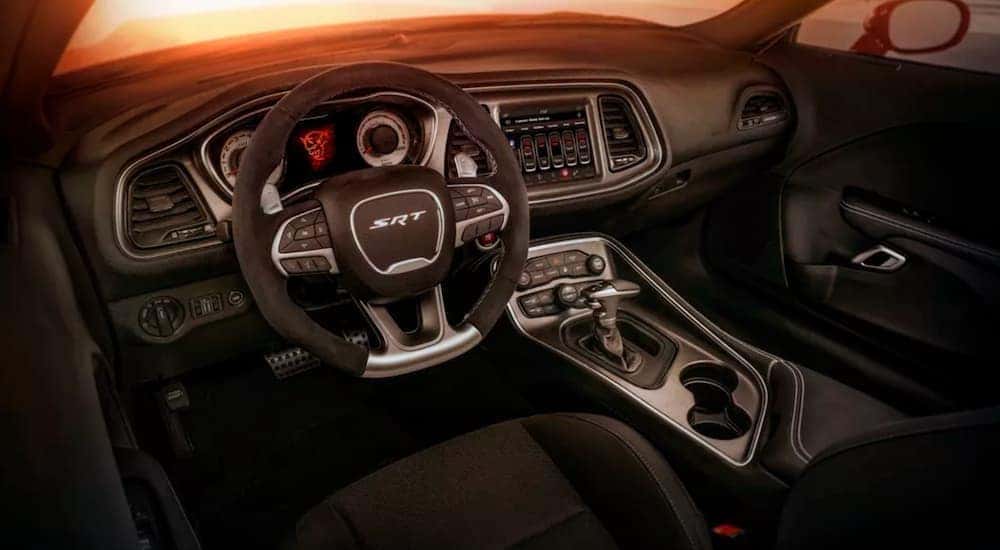
The 2018 Challenger includes some updates to equipment and performance, including an available Performance Handling package that can be added to the two base engines. But the headline news is the addition of the SRT Demon with record-setting horsepower. The Challenger SXT comes with a 3.6L V6 that produces 305 hp and 268 lb-ft of torque. Moving to the R/T trim gets you the pushrod 5.7L V8 engine with a six-speed manual transmission and an output of 375 hp and 410 lb-ft of torque. The R/T Scat Pack’s engine is a pushrod 6.4L V8 producing 485 hp and 475 lb-ft of torque.
The SRT Hellcat houses a supercharged pushrod 16-valve 6.2L V8 with a hairraising 707 hp and 650 lb-ft of torque. One of the wildest cars ever built by Dodge, the limited-production 2018 Hellcat Demon is loaded with drag-racing equipment. The Demon’s supercharged HEMI 6.2L V8 has an insane, Fast & Furious-worthy 808 hp on 91 octane gas and can top out at 840 hp if the tank is filled with 100 octane race gas. Unfortunately, this model was discontinued after 2018, making it a rare find in the automotive landscape.
2019 Challenger Engines
For 2019, Dodge added a rear-wheel drive version of the Challenger G/T trim, which had previously only been available in all-wheel drive. Mostly, the specifications stay the same across the board. The engines include the SXT’s 3.6L V6, the R/T’s 5.7L V8, and the R/T Scat Pack’s 6.4L V8, each maintaining the same outputs as previous years. The change in 2019 comes from the SRT Hellcat’s modified engine and the introduction of the SRT Hellcat Redeye.
While this improvement to the 2019 SRT Hellcat doesn’t serve to replace the discontinued SRT Demon from 2018, it does pay homage to that vehicle. The 2019 SRT Hellcat has its supercharged 6.2L V8 now producing 717 hp and 656 lb-ft of torque, up 10 hp from previous years. However, moving into the new SRT Hellcat Redeye bumps the engine output up to 797 hp, putting it within spitting distance of the fabled SRT Demon.

2020 Challenger Engines
For 2020, the engine sizes and capabilities remain the same as in previous years for the SXT, GT, R/T, R/T Scat Pack, SRT Hellcat, and SRT Hellcat Redeye. However, there is a new kid on the block for the 2020 lineup: the SRT Super Stock. Inching even closer to the output of the SRT Demon, the SRT Super Stock is equipped with a souped-up supercharged 6.2L V8 to blow all other V8s out of the water. Boasting 807 hp and 707 lb-ft of torque, it roars down any street or drag strip with authority.
2021 Challenger Engines
The 2021 lineup of Dodge Challengers closely resembles that of the 2020 models. The standard SXT and GT base engine is a 3.6L V6 with 303 hp and 268 lb-ft of torque. This option is still only available with the eight-speed automatic transmission. The three V8 engines include the 6.4L V8 on the R/T Scat Pack, the slightly smaller 5.7L HEMI V8 on the R/T, and the supercharged 6.2L V8 that delivers 717 hp in the SRT Hellcat, 797 hp in the SRT Hellcat Redeye, or 807 hp in the SRT Super Stock. All three V8 options are available with either an eight-speed automatic or six-speed manual transmission. The 2021 Challenger comes in both rear-end drive and all-wheel drive variations.
2022 Challenger Engines
As for 2022’s Challenger, Dodge takes the statement, “if it ain’t broke, don’t fix it,” to task. For 2022, Dodge kept all the engines of the 2021 lineup but added the SRT Jailbreak. This new option has the same high-output supercharged 6.2L Hellcat engine as the SRT Super Stock but offers the whole catalog of customization options to make the Jailbreak your vision of the ideal muscle car. As with other years, the SRT Hellcat, the SRT Hellcat Redeye, and the SRT Super Stock are not for the faint of heart. These three options continue to pump out 717, 797, and 807 hp, respectively.
Which Dodge Challenger Is Right for You?
Since 2015, the Dodge Challenger has unleashed a selection of fun, dynamic, and thrilling engine configurations. There is a wide array to choose from, with an engine option suited to everyone’s needs. Whether you’re going for the more tame 305 hp V6 or springing for the outrageously powerful supercharged Hellcat V8, every variant of the Challenger presents an opportunity to take to the roads and own them. The savviest buyers know they can get a great deal by buying used, thanks to the more competitive pricing. Once you narrow down all of your options, what’s stopping you from hitting the road in the Dodge Challenger of your dreams?
0 comment(s) so far on Shopping for a Used Dodge Challenger? Here’s Your Engine Guide